
 0
0
 0
0
If you’re considering a low-mileage 2010 Chevy Volt, weigh the benefits and drawbacks carefully. It offers great savings on fuel and a unique hybrid setup, but you need to inspect its battery health and maintenance history. The battery’s longevity is often affected more by age than mileage, leading to potential issues. Owner satisfaction is generally high, but common problems exist. Keep exploring to uncover what you should know before making your decision.
What Is the Chevy Volt and Why Consider It?

The Chevy Volt is a plug-in hybrid electric vehicle that combines electric and gasoline propulsion, making it a versatile option for many drivers.
With an impressive electric range of 30-40 miles, it’s perfect for your daily commute while still providing the flexibility of a gasoline engine for longer trips.
The 2010 model features a reliable 16.0 kWh battery that shows minimal degradation, ensuring you get the efficiency you need.
The reliable 16.0 kWh battery in the 2010 Volt offers impressive efficiency with minimal degradation.
If you’re considering used cars, the Volt often comes at a budget-friendly price, usually below $14,000, making it an attractive choice for anyone looking to shift to electric driving without the hefty upfront costs of a new EV.
You’ll enjoy high owner satisfaction and lower emissions, too! Additionally, being aware of battery replacement costs can help you prepare for potential expenses in the future.
Key Features of the 2010 Chevy Volt
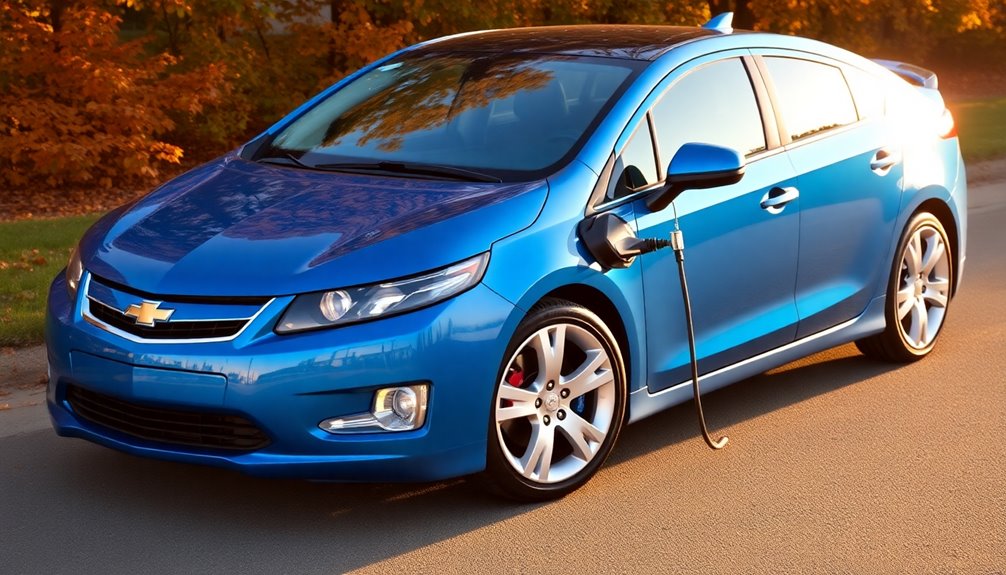
Here’s what makes it a remarkable option:
- 16.0 kWh lithium-ion battery provides an electric range of approximately 35 miles.
- 1.4-liter four-cylinder gasoline engine extends your total driving range to over 300 miles.
- Regenerative braking system recharges the battery while driving, enhancing efficiency.
- Standard features include a rearview camera and Bluetooth connectivity for convenience.
- Premium audio system offers a comfortable and tech-savvy driving experience.
The Chevy Volt’s impressive battery capacity and advanced technology make it one of the pioneering plug-in hybrids, showcasing a unique blend of performance and practicality. Additionally, its efficiency mirrors the benefits of geothermal heat pumps, which can lead to significant energy savings.
Understanding the Low-Mileage Advantage

Buying a low-mileage 2010 Chevy Volt can offer significant advantages, as it typically indicates less wear and tear on essential components.
With around 30,000 miles, you’re likely looking at a vehicle that’s been driven far less than average, enhancing its overall condition. Low-mileage cars often provide better performance metrics, making them appealing options.
However, keep in mind that battery degradation is influenced more by age than mileage. Since the Volt’s battery warranty lasts for 8 years or 100,000 miles, a 2010 model may no longer be covered, potentially leading to higher repair costs.
Still, if you find a well-maintained low-mileage Chevy Volt, it could be a worthwhile bargain, often priced under $5,000. Additionally, regular maintenance, such as filter changes, can improve the overall efficiency and longevity of any vehicle, including hybrids like the Volt.
What to Know About Battery Longevity
When considering a low-mileage 2010 Chevy Volt, it’s important to understand how battery longevity plays into your decision.
Keep in mind these key points about battery degradation:
- Calendar age affects battery performance more than mileage.
- Gen 1 Volt batteries are nearing the end of their life expectancy.
- Battery warranties generally cover 8 years or 100,000 miles.
- With proper maintenance, both Gen 1 and Gen 2 Volts can reach high mileage with minimal degradation.
- Regular battery health tests are crucial for evaluating longevity before purchase.
- Utilizing budget apps can help you manage the costs associated with potential maintenance and repairs, ensuring you’re financially prepared for ownership.
Understanding these factors will help you gauge the potential lifespan of the battery and guarantee you make an informed choice about your investment.
Common Issues Faced by 2010 Volt Owners
As a potential buyer of a low-mileage 2010 Chevy Volt, you should be aware of some common issues that owners face. Battery health concerns, EGR valve problems, and the importance of maintenance history can greatly impact your experience with the vehicle. Additionally, understanding the long-term care costs associated with maintaining older vehicles is crucial for budgeting and planning. Staying informed about these factors will help you make a better decision.
Battery Health Concerns
Battery health is an important concern for anyone considering a low-mileage 2010 Chevy Volt, especially since the vehicle’s 16.0 kWh battery may have experienced significant degradation over the years.
Before making a purchase, you should be aware of common issues faced by Volt owners:
- Diminished battery capacity
- Reduced electric range (around 30-40 miles)
- Potential high replacement costs (likely out of warranty)
- Performance issues affecting driving experience
- Importance of a battery health test
Understanding these factors can help you assess the Volt’s current performance and remaining life.
A thorough check can save you from unexpected expenses and guarantee you make a well-informed decision.
Don’t overlook battery health; it’s vital for your Volt ownership experience.
EGR Valve Issues
One common issue that 2010 Chevy Volt owners encounter is EGR (Exhaust Gas Recirculation) valve problems.
These issues can lead to decreased engine performance and increased emissions. You might notice symptoms like rough idling, poor acceleration, or a check engine light illuminating.
EGR valve failures can happen as early as 50,000 miles, resulting in costly repairs or replacements. A malfunctioning EGR valve can hinder your vehicle’s ability to switch between electric and gasoline power, which impacts overall efficiency.
Regular maintenance and timely diagnosis of EGR valve issues are essential to prevent further engine damage and guarantee your Volt lasts longer. Keeping an eye on this component can save you money and keep your driving experience smooth.
Maintenance History Importance
Maintaining a 2010 Chevy Volt goes beyond just addressing EGR valve issues; understanding its maintenance history is vital for evaluating the vehicle’s reliability.
A well-documented service history can reveal how well the previous owner cared for the car, affecting your investment.
Here are some common issues to look out for:
- Battery degradation over time
- Potential issues with the battery energy control module (BECM)
- Concerns about the electric drive unit
- Importance of regular servicing and software updates
- Need for battery health checks to guarantee efficiency
Evaluating Total Cost of Ownership
When you’re considering a low-mileage 2010 Chevy Volt, it’s important to look beyond the initial purchase price and explore the total cost of ownership.
You’ll want to account for potential long-term expenses, like battery degradation, which affects this model more due to its age than mileage. As the battery nears the end of its life, you might face hefty replacement costs.
Don’t forget to factor in maintenance costs, which can vary but are generally comparable to other compact hatchbacks. Additionally, you can save around $20,000 on gas over ten years, helping offset ownership costs.
Finally, insurance rates are reasonable, making the Volt a more appealing choice when evaluating overall expenses. Moreover, considering that heat pumps can lead to significant long-term savings due to their high energy efficiency, it may be worth exploring alternative energy options for your home to further reduce costs.
How Does the 2010 Volt Compare to Later Models?
When you compare the 2010 Chevy Volt to later models, you’ll notice significant upgrades in battery performance and technology. The 2010 model offers just 35 miles of electric range, while newer versions boost that to 50 miles, thanks to advanced battery chemistry. Plus, later models come with enhanced features that make driving and managing your energy use much easier. Additionally, battery replacement in older electric vehicles can be costly, potentially impacting the overall value of the car.
Battery Performance Differences
The 2010 Chevy Volt’s battery performance shows significant differences when compared to later models. Here are some key points to evaluate:
- The 2010 Volt has a 16.0 kWh battery with an electric range of 30-40 miles.
- Later models (2016-2019) offer an improved range of about 50 miles.
- Battery degradation in the 2010 Volt may be more pronounced due to age.
- Improved battery chemistry in later models results in better reliability and longevity.
- The warranty for the 2010 Volt is 8 years/100,000 miles, while later models can extend to 10 years/150,000 miles.
Technology Advancements Over Time
Although the 2010 Chevy Volt was groundbreaking at the time of its release, it falls short compared to later models regarding technology advancements. The 2010 Volt features a 16.0 kWh battery, offering an electric range of about 35 miles.
In contrast, the 2016-2019 Gen 2 Volt boasts an 18.4 kWh battery, greatly increasing the electric range to up to 50 miles. Additionally, later models benefit from improved battery chemistry, which includes liquid cooling and better materials, enhancing thermal management and reducing degradation.
The 2010 Volt also lacks many modern features found in newer models, such as advanced driver assistance technologies and enhanced infotainment systems.
Ultimately, advancements in battery technology and vehicle infrastructure make later models a more appealing option.
Assessing Reliability and Warranty Options
While evaluating a low-mileage 2010 Chevy Volt, it’s essential to assess its reliability and warranty options. You might find that many of these first-generation models have no remaining manufacturer warranty, which could lead to higher repair costs.
Here are some key points to reflect on:
- Battery warranty may have expired, raising concerns over battery degradation.
- Common reliability issues include electronic component failures.
- A well-maintained Volt can still perform reliably.
- Pre-purchase inspections are vital to assess vehicle condition.
- Specific warranty coverage for repairs may not apply to the 2010 model.
Understanding these factors can help you make an informed decision about the potential risks and rewards of owning a low-mileage 2010 Chevy Volt. Additionally, considering budgeting for repairs can help you prepare financially for any unexpected maintenance costs that may arise.
Importance of Maintenance History for Used Cars
When considering a low-mileage 2010 Chevy Volt, examining the maintenance history can reveal a lot about its overall condition and reliability. A well-documented maintenance history indicates how the previous owner cared for the vehicle, especially regarding battery health.
Regular maintenance records, including battery checks and repairs, help assess the Volt’s longevity and reliability, essential since battery age affects performance. Look for vehicles with complete service histories, as they typically have better resale values and fewer unexpected repairs.
Prioritize cars that were garage-kept or have routine service records, which often correlate with better overall condition. Finally, obtain a vehicle history report to gain insights into previous ownership and maintenance practices, helping you make informed decisions about your used Chevy Volt. Additionally, considering the average price of used cars, which is significantly lower than new vehicles, can enhance your financial decision-making when purchasing a used car.
Will the 2010 Volt Meet Your Driving Needs?
Are you wondering if the 2010 Chevy Volt can fit your driving needs? The Volt offers unique features that might suit your lifestyle, especially if you prioritize short trips.
Considering a 2010 Chevy Volt? Its unique features cater to short trips, making it a great fit for urban lifestyles.
Consider these points:
- Electric range of 30-40 miles for daily commutes
- Gasoline engine backup for longer drives
- 16.0 kWh battery pack with an 8-year warranty
- Affordability compared to newer models
- Ideal for urban driving with limited charging access
While used Volts can be a cost-effective choice, be mindful of potential battery degradation after 10 years. Additionally, using an expense tracking app can help you simplify expense management as you budget for owning and maintaining the vehicle.
If the battery health is good and maintenance history checks out, this car could be perfect for your short-distance driving needs.
Just verify it aligns with your specific requirements before making a decision.
Resale Value Trends for the Chevy Volt
As you consider the resale value trends for the Chevy Volt, you’ll find that its unique combination of electric and gasoline capabilities often leads to a more favorable market position compared to similar-aged gasoline vehicles.
Currently, a 10-year-old used Volt has an estimated resale value between $9,000 and $12,000, reflecting its durability and increasing market demand. Limited availability of used Volts further enhances their resale potential, making them more appealing for buyers.
Additionally, as battery replacement costs decline and the vehicle’s mechanical durability remains strong, the long-term resale value of well-maintained Volts may improve.
Owner Experiences and Satisfaction Levels
When considering a low-mileage 2010 Chevy Volt, you’ll want to hear from current owners about their long-term experiences.
Many drivers praise its reliability and efficiency, but common issues can arise as the car ages. Understanding these insights can help you make a more informed purchasing decision.
Long-Term Ownership Experiences
Many Chevy Volt owners express a high level of satisfaction, particularly because the vehicle’s design greatly lowers fuel costs and reduces dependence on gasoline for everyday driving.
Long-term ownership experiences reveal several key benefits:
- Significant reduction in fuel expenses
- Longevity, with some models reaching 300,000 miles when properly maintained
- Electric range alleviating range anxiety for most trips
- Importance of regular maintenance positively impacting battery health
- Reliability thanks to the backup gasoline engine for longer journeys
Common Issues Encountered
While the 2010 Chevy Volt offers a satisfying driving experience for many, it’s essential to be aware of some common issues that owners have encountered.
Battery health is a primary concern, especially as the vehicle ages beyond 150,000 miles. Owners often report degradation, which can lead to costly repairs. Though the Volt can reach over 300,000 miles, maintaining a rigorous service history is critical for reliability.
Common issues include battery management system faults and EGR valve problems, though the 2010 model has shown resilience against major mechanical failures. Satisfaction levels remain high, with many appreciating its electric-gasoline blend.
Well-maintained examples can still command fair resale prices, despite potential battery replacement costs affecting overall value.
What to Look for in a Used Volt Purchase?
Buying a used 2010 Chevy Volt can be a smart choice, but you need to know what to look for to guarantee a sound investment. Here are some key factors to take into account:
Consider key factors like battery health and maintenance history when buying a used 2010 Chevy Volt for a smart investment.
- Battery health: Prioritize checking for battery degradation, as it’s more affected by age than mileage.
- Maintenance history: Look for documentation of regular service to assure reliability and better long-term performance.
- Battery performance: Test the battery using diagnostic tools, especially when it’s low, to assess its current state.
- Chronic issues: Be cautious of known problems like battery management system failures and make certain inspections cover these.
- Warranty status: Evaluate any remaining manufacturer warranty to ease concerns about future repairs.
Taking these steps can help you make an informed decision.
Tools for Battery Health Testing Before Buying
When considering a used 2010 Chevy Volt, understanding the battery’s health is essential to your investment.
To assess battery health effectively, utilize diagnostic tools like the ELM 327 v1.5 or vLinker MC+. These devices can provide valuable insights into performance metrics.
For battery testing, apps such as Voltage for Android and MyVoltControl for iOS are recommended; they allow you to monitor battery status in real time. It’s best to conduct tests when the Volt’s range is low, ideally with only 3-5 miles left.
Running the climate control at maximum temperature during testing can also reveal potential issues. Don’t forget to obtain a thorough battery health report, like a state of health (SOH) assessment, before making your purchase.
Final Thoughts: Should You Buy a 2010 Chevy Volt?
Is a low-mileage 2010 Chevy Volt worth your investment? While its low mileage might seem appealing, consider these critical factors before deciding:
- Battery degradation could affect performance and longevity.
- The electric range is limited to about 30-40 miles, which may not meet your daily needs.
- Maintenance costs may rise due to its age, potentially offsetting savings.
- It’s missing many advanced features and reliability improvements found in newer models.
- The resale value is likely lower, making it essential to weigh repair costs against the purchase price.
Conclusion
In the grand scheme of automotive history, the 2010 Chevy Volt might just be the hidden gem you never knew you needed. With its low mileage and eco-friendly charm, it could whisk you away on an electrifying journey of savings and satisfaction. But beware! If you ignore the battery’s health and common pitfalls, you might find yourself stranded in a world of regret. So, buckle up and choose wisely—your future rides depend on it!




Average Rating